Looking for free ai video tools? This review shows what happens when a free Higgsfield account meets a text-to-video prompt, and whether its free balance can produce a clip.
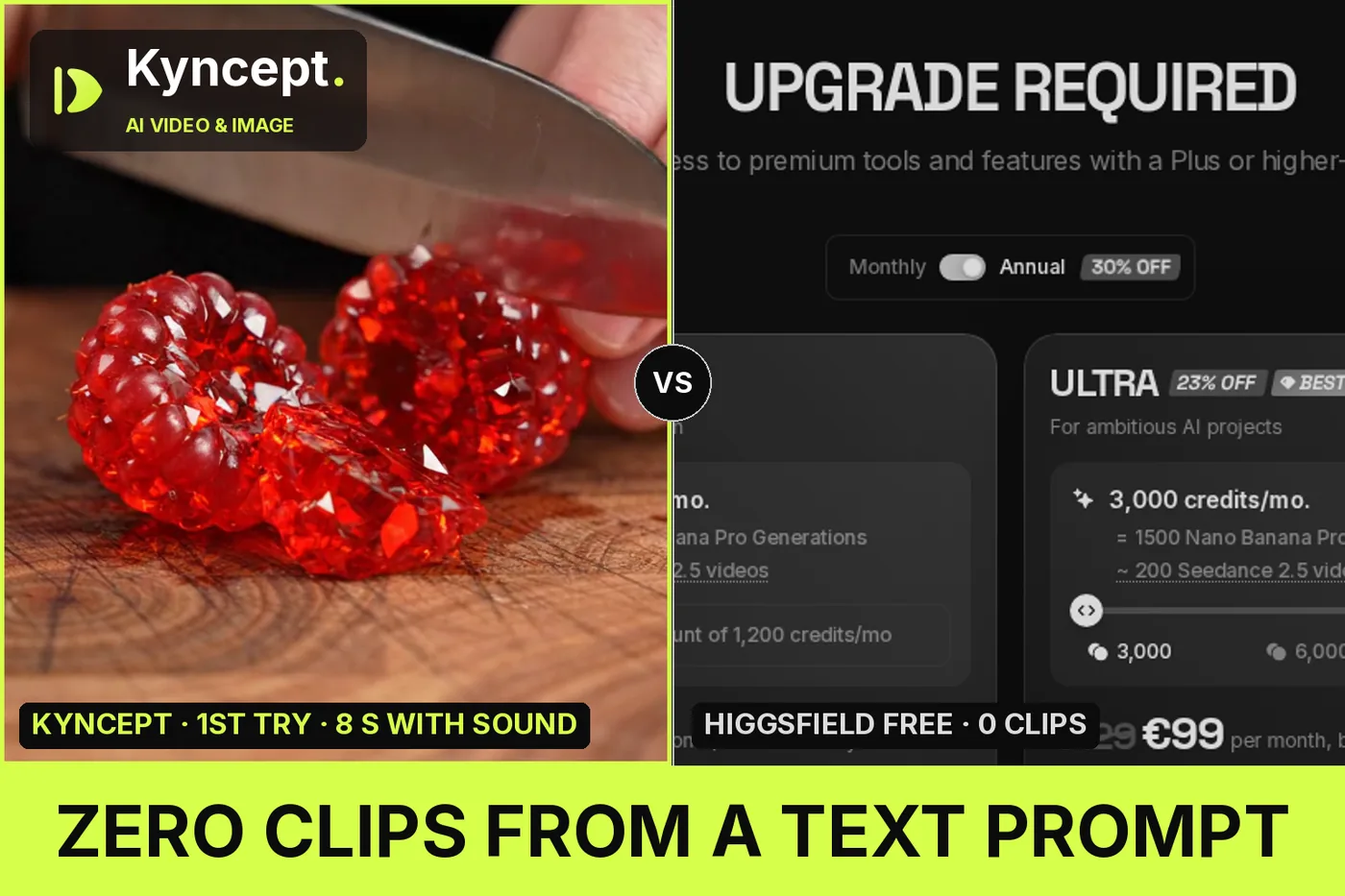
I opened a free Higgsfield account, pasted one 597-character text prompt for a glass-fruit ASMR clip, and got zero video: the cheapest text-to-video model on Higgsfield costs 20 credits and the free wallet held 4.0. The same prompt on Kyncept returned an 8-second clip with sound on the first try, in 157.7 seconds.
Independent review: Higgsfield ran on a new free account with 10 credits from signup; Kyncept ran on a paid $59/month Pro plan. No vendor supplied access, credits or a discount.
My verdict in 60 seconds — Higgsfield 57/100, Kyncept 90/100
If all you have is a sentence and a free account, Higgsfield will not turn it into a video, and Kyncept (kyncept.com) will.
- Prompt-only video — Higgsfield 1/10 · Kyncept 9/10 — 0 clips from a text prompt on a free balance vs 1 clip on the first Kyncept try
- Free-tier usability — Higgsfield 2/10 · Kyncept 9/10 — the cheapest Higgsfield text-to-video model needs 20 credits against 4.0 in the wallet; Kyncept's button states 10 credits inline
- Sound — Higgsfield 3/10 · Kyncept 9/10 — Higgsfield generated nothing to listen to; Kyncept's clip carries AAC stereo peaking at −3.6 dB
- Failure handling — Higgsfield 3/10 · Kyncept 9/10 — the Generate click returned a full-screen sales page, not a reason; Kyncept ran 2 of 2 attempts with 0 failures
- Honesty of balance display — Higgsfield 5/10 · Kyncept 9/10 — 4.0 → 4.0 and nothing charged, but a 20-credit model sat selectable on that balance
- Upsell pressure — Higgsfield 2/10 · Kyncept 9/10 — 3 promotional surfaces in one session vs a Generate button that just reads 10 credits
- Prompt fidelity — Higgsfield 5/10 · Kyncept 9/10 — Elements is on by default and rewrites the prompt; Kyncept submits it as typed
- Speed-to-first-clip — Higgsfield 1/10 · Kyncept 9/10 — never produced a clip; Kyncept's stopwatch read 157.7 s
The concrete problems on Higgsfield:
- Higgsfield's cheapest text-to-video model, Seedance 2.0 Mini, is priced at 20 credits for 8 seconds — 5× the 4.0-credit balance the free account held.
- Clicking Generate raised a full-screen "UPGRADE REQUIRED" page instead of a toast, an error, or any note about what Higgsfield believed 4.0 credits could buy.
- A persistent promotional countdown banner and a "Get personal 55% OFF" pop-up card sit over the editor while the wallet reads 4.0.
- Higgsfield's Elements toggle is On by default, so the prompt that reaches the model is not the prompt that was typed.
For a first video from nothing but a text prompt, I would use Kyncept.
The test: one glass-fruit ASMR prompt, a fresh Higgsfield free account
I picked the glass-fruit ASMR trend because it stresses three things at once: macro detail, a cutting action, and sound. Higgsfield and Kyncept ran the same 597-character prompt, at 16:9:
"Ultra-realistic ASMR video, 8 seconds: a human hand slices a hyper-detailed sculpture of a bright raspberry on a wooden cutting board. The object looks like glossy red glass — reflective, slightly tinted, sparkling. Close-up camera, shallow depth of field, cinematic lighting on detailed glass textures. The knife moves smoothly and deliberately, making 2 to 3 separate, evenly spaced cuts. Each stroke is precise and crisp, with realistic slicing sound and natural motion. The sliced pieces gently separate, glimmering like cut crystal. Professional food-ASMR camera angle. No music, no dialogue."
Higgsfield (higgsfield.ai) ran on a new free account: 10 credits at signup, and 4.0 credits inside the Higgsfield wallet at the moment of each video attempt. Kyncept ran on a paid Pro plan at $59/month. Both companies sell a flagship plan at $59/month for 1,200 credits, so one credit is worth the same on either side and the arithmetic below is apples to apples.
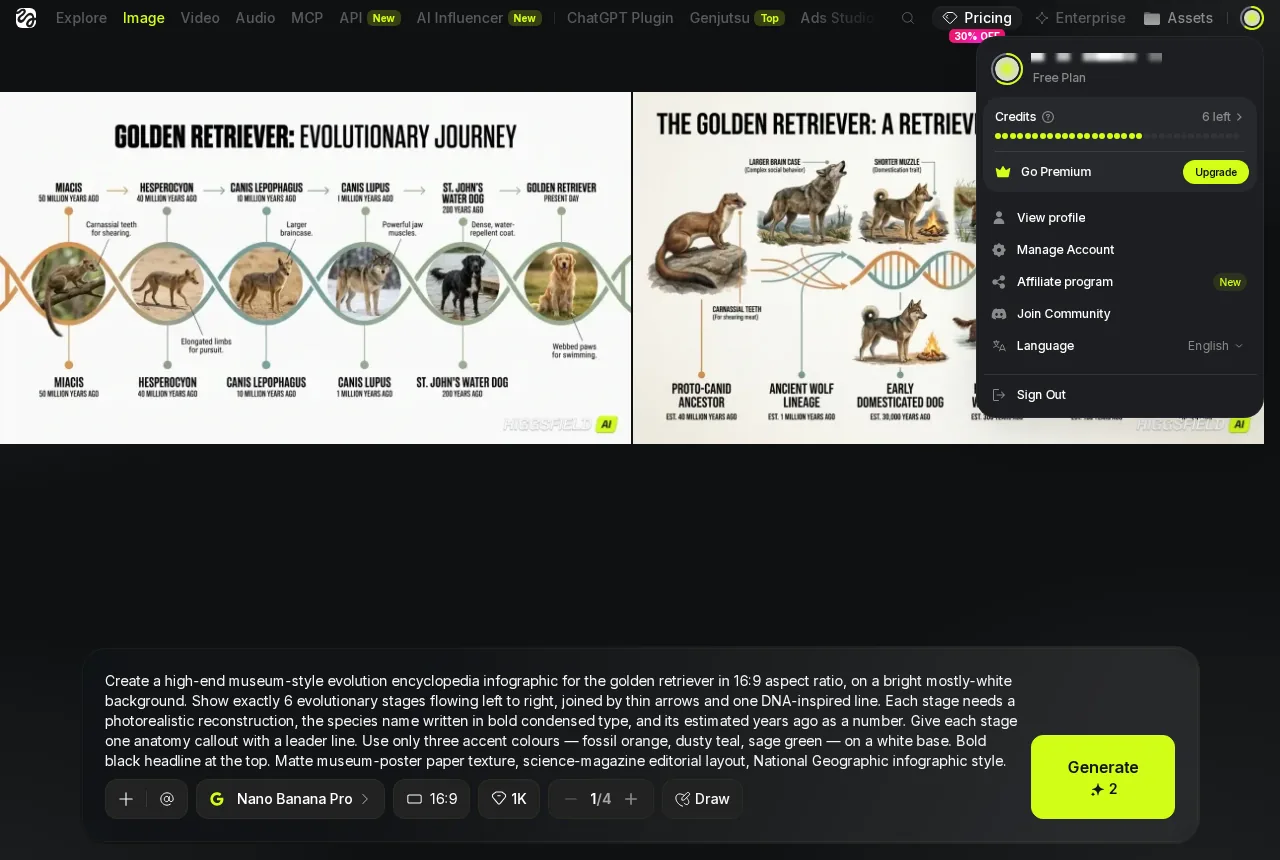 The Higgsfield account menu: 4.0 credits, the balance every video attempt was measured against.
Seedance 2.0 Mini on Higgsfield: 20 credits for 8 seconds, then a full-screen wall
With 4.0 credits in the wallet, one question matters: what does the cheapest Higgsfield text-to-video model cost? In the Higgsfield video editor the answer is Seedance 2.0 Mini — 8 seconds, 720p, and a Generate button that reads "Generate 20 · 8", which is 20 credits for an 8-second clip. That is exactly 2× the 10 credits Kyncept charges for the same eight seconds.
Higgsfield's own pricing table backs that up: "~ 80 Seedance 2.5 videos" per 1,200 credits works out to 15 credits each, so 20 for the cheapest model in the store is no anomaly.
Then I clicked Higgsfield's Generate button. 4.0 is less than 20, so I expected a plain "not enough credits". Instead Higgsfield opened a full-screen "UPGRADE REQUIRED — Get access to premium tools and features with a Plus or higher-tier plan." No toast, no queued job, no charge: the balance read 4.0 before the click and 4.0 after it. That is the entire Higgsfield free-tier video outcome — 0 clips, 0 seconds of footage, 0 bytes to download.
- Price of one 8-second text-to-video clip — Higgsfield 20 credits (Seedance 2.0 Mini) · Kyncept 10 credits · 2×
- Clips on a 1,200-credit plan — Higgsfield 60 · Kyncept 120 · 2×
- Free balance against the cheapest model — Higgsfield 4.0 credits vs 20 required · 5× short
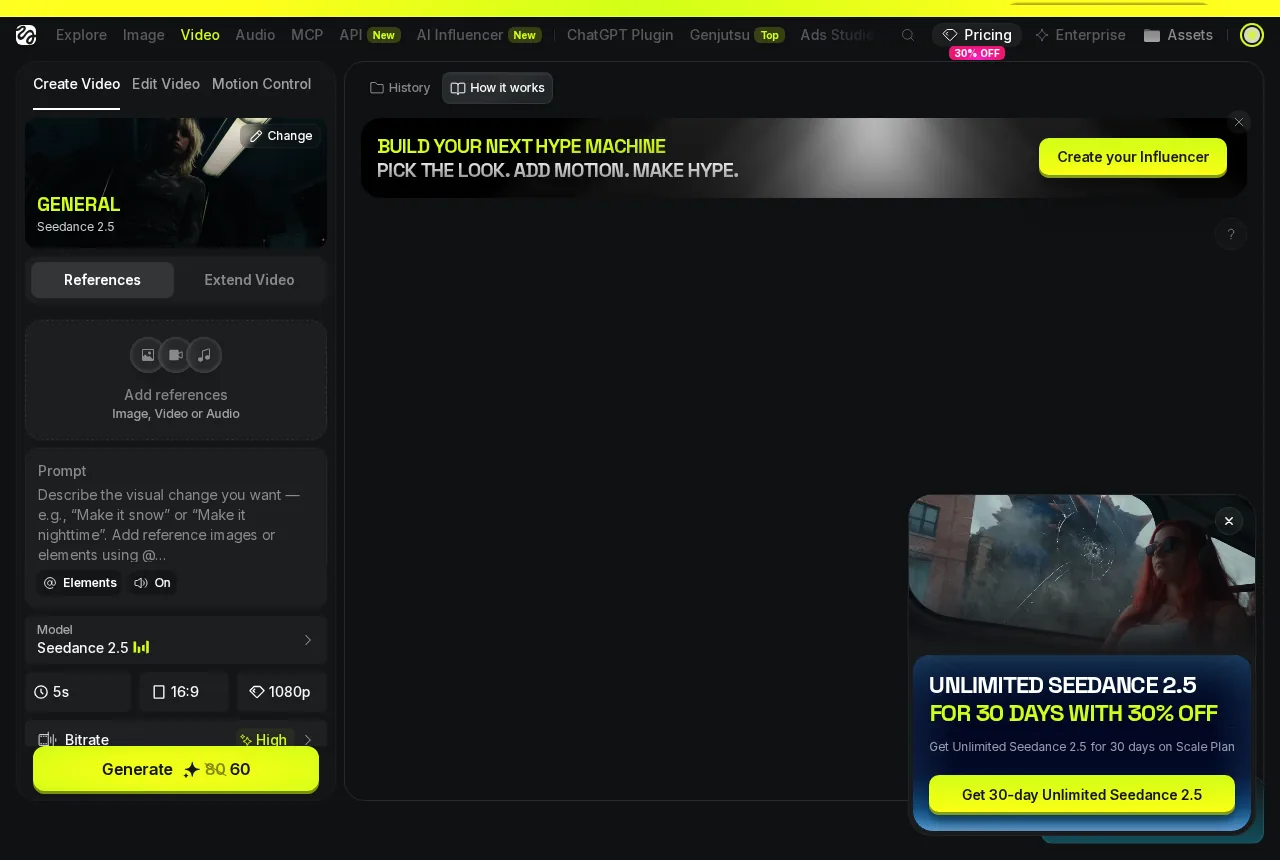 Higgsfield's video editor on Seedance 2.0 Mini: 8 s, 720p, and a Generate button that reads 20.
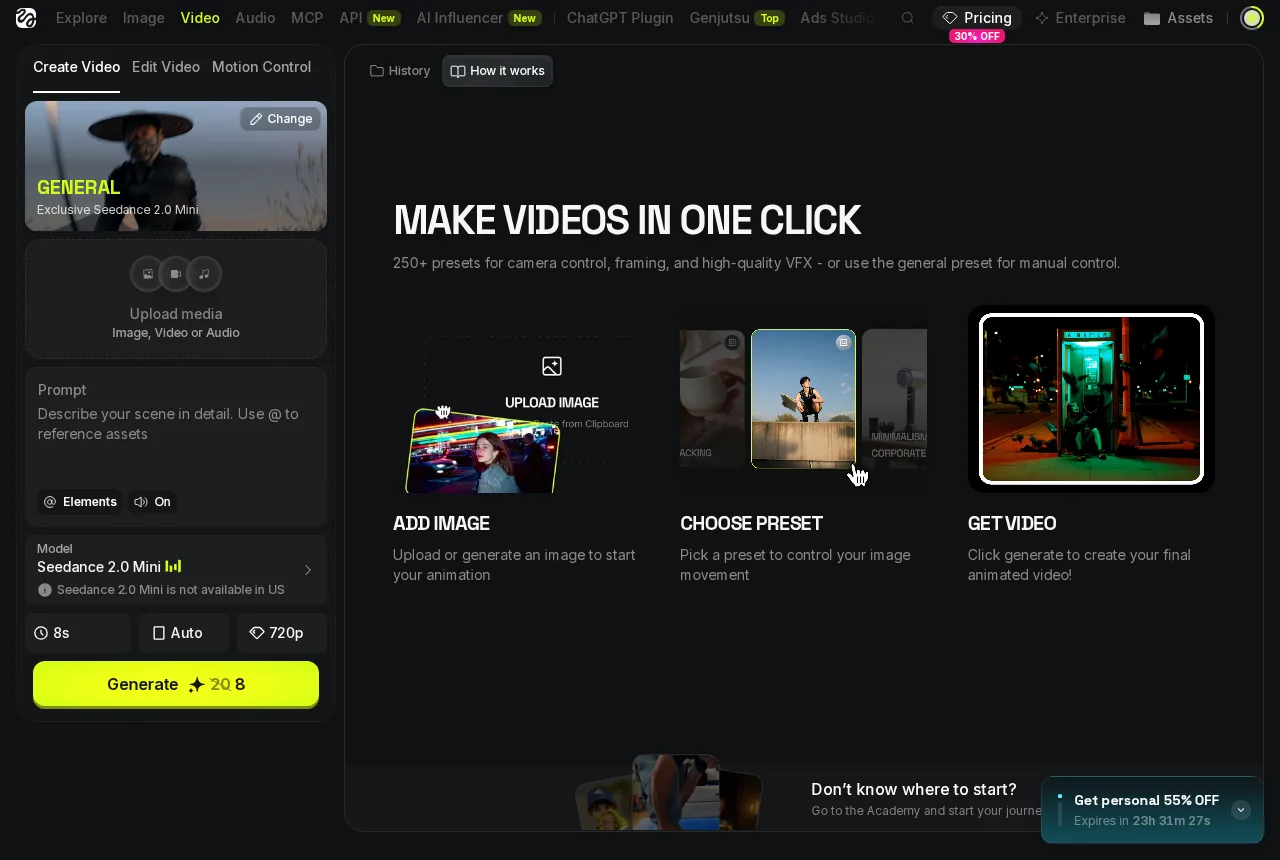 The same 8-second 720p clip, priced at 20 credits in Higgsfield's own cost panel.
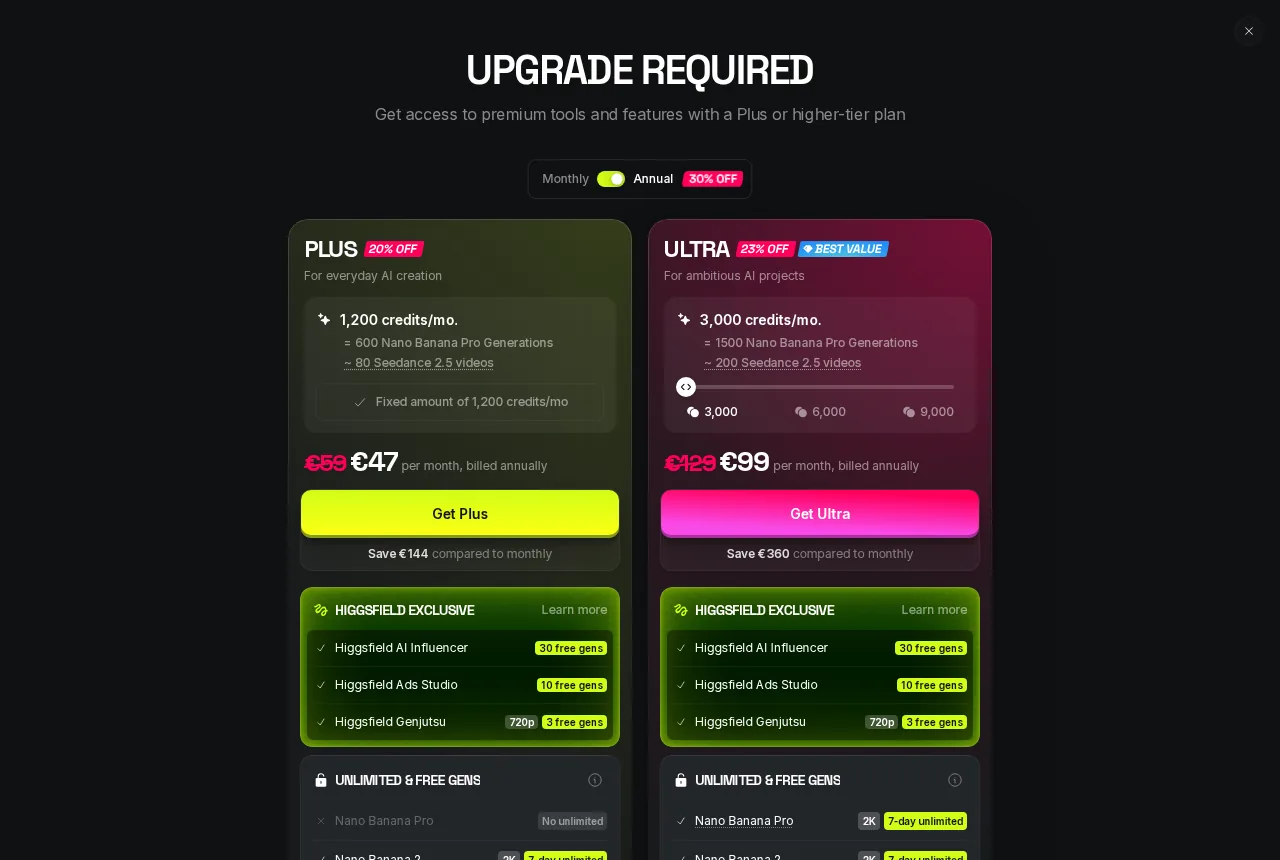 What a Higgsfield free account gets instead of a clip: a full-screen UPGRADE REQUIRED page.
Three promotional surfaces in one session, on a 4.0-credit wallet
The Higgsfield upgrade wall was not the only thing selling. In the same session I counted three promotional surfaces: a persistent countdown banner above the editor, a "Get personal 55% OFF" pop-up card over its lower-right, and the full-screen upgrade page the Generate click produced. The wallet held 4.0 credits throughout, so all three were pitched at someone who had not yet generated a single frame on the platform.
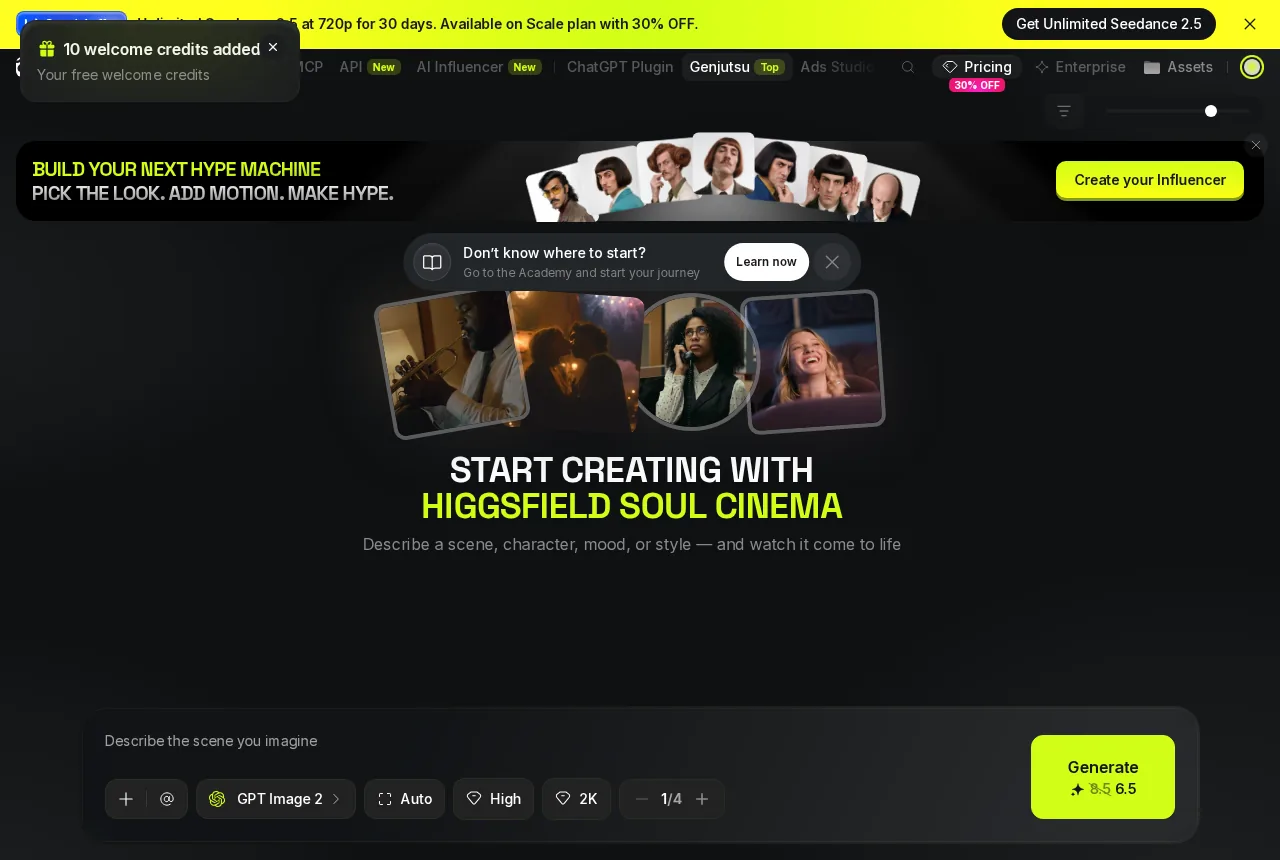 Higgsfield's model list on load: PREMIUM badges on the paid models, and the promotional countdown banner above them.
Higgsfield's 28-model catalogue against a 4.0-credit balance
Higgsfield's video picker lists 28 models, and the wider Higgsfield product ships 250+ camera presets. That is a genuinely large catalogue and I will not pretend otherwise. The exchange rate is what decides it: the cheapest entry in that catalogue costs 20 credits, and a free balance holds 4.0 — 20 divided by 4.0 is 5, so a Higgsfield free account cannot touch any of the 28. Not the cheapest one, not the newest one, not one.
Two more free-tier details come off the same screens. The Higgsfield Seedance 2.0 Mini row carries a note that the model is not available in the United States. And concurrency is capped: Higgsfield's feature table gives Free 1 concurrent job, Starter 2, Plus 4, Ultra 8 — so on a free Higgsfield account there is no second slot in which to queue a backup attempt while the first one runs.
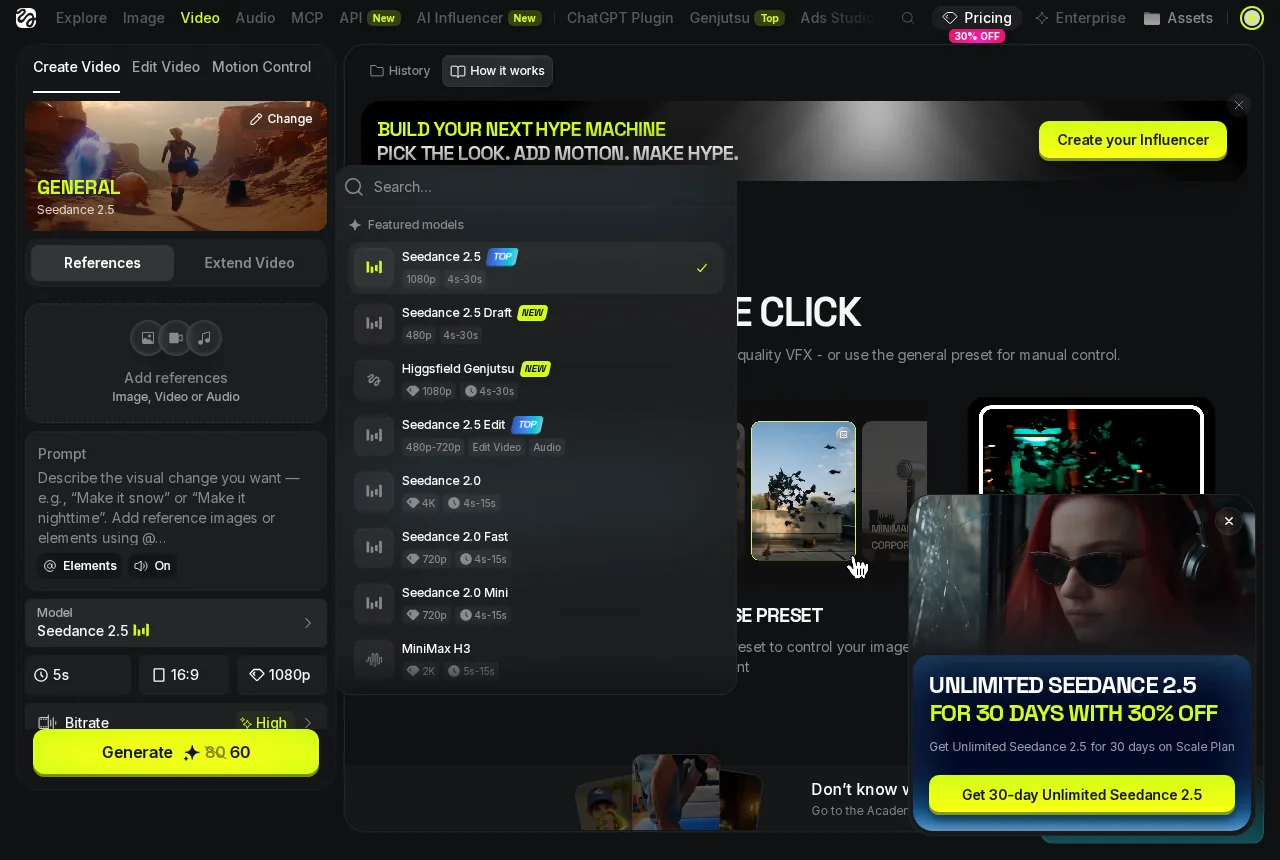 Higgsfield's 28-model video list: large, and unreachable on a 4.0-credit free balance.
Kyncept: the same prompt, first try, 157.7 seconds
On Kyncept I opened the video page for Kyncept Plus, its own video model. The Generate button reads 10 credits, first frame and last frame are both labelled Optional, and no image is needed to start.
I pasted the same 597-character prompt, kept 16:9, and pressed Generate. The balance dropped from 242 to 232 — exactly 10 credits. The UI stopwatch stopped at 157.7 seconds. Two attempts produced two clips, 0 failures, and no charge that failed to turn into a file.
One difference is worth naming. A Higgsfield video editor carries an Elements toggle set to On by default, which references assets with an "@", so the prompt that reaches the model is not necessarily the prompt that was typed. Kyncept submits the prompt as typed. Both cap input length in opposite directions: Higgsfield accepted a 1,600-character prompt untruncated, Kyncept truncates at 1,500.
- First-try outcome — Higgsfield 0 clips (4.0 credits vs a 20-credit model) · Kyncept 1 clip in 157.7 s · no comparison
- Balance movement for that attempt — Higgsfield 4.0 → 4.0 · Kyncept 242 → 232 · 0 vs 10 credits
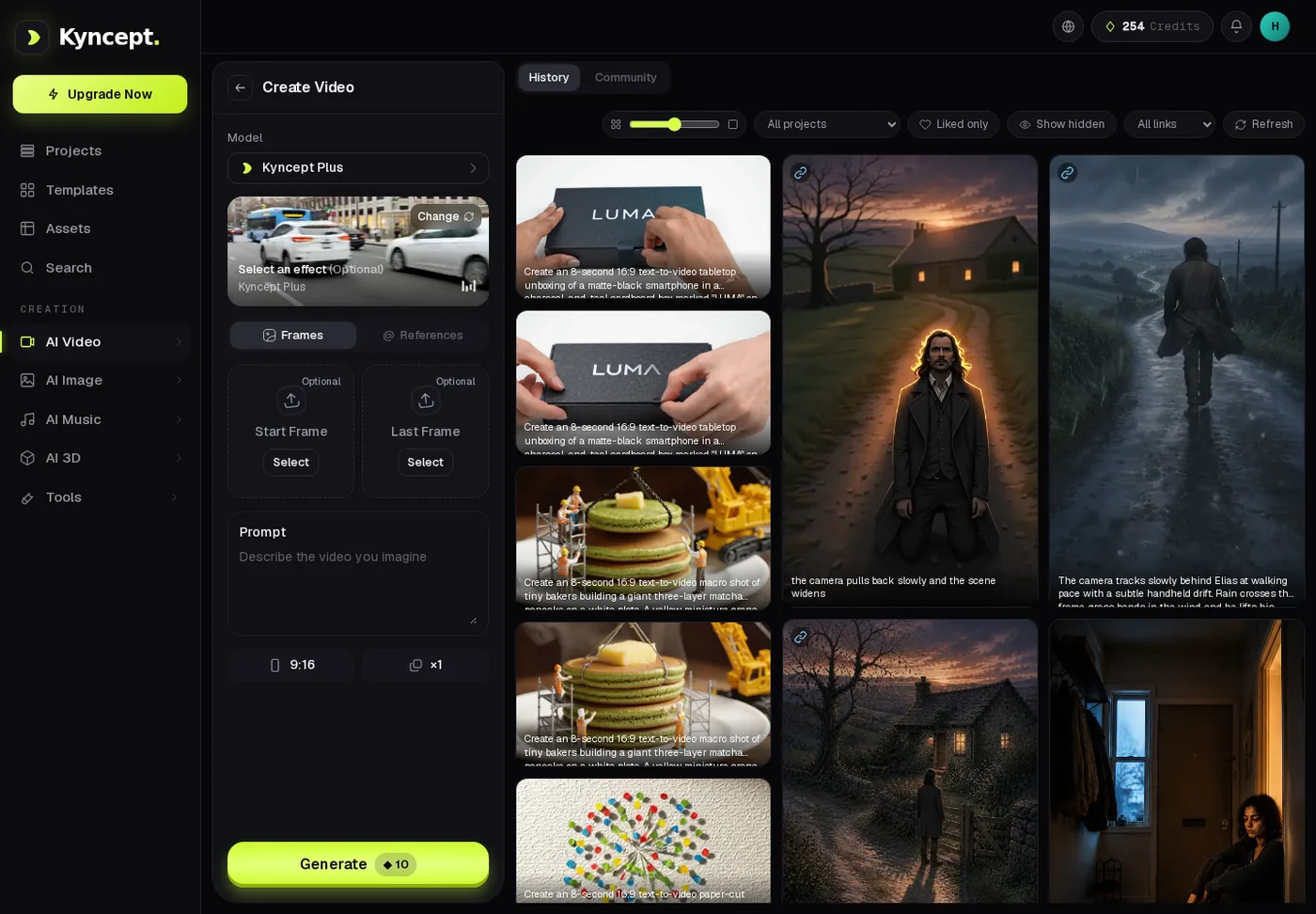 Kyncept's video page: first and last frame both Optional, Generate at 10 credits.
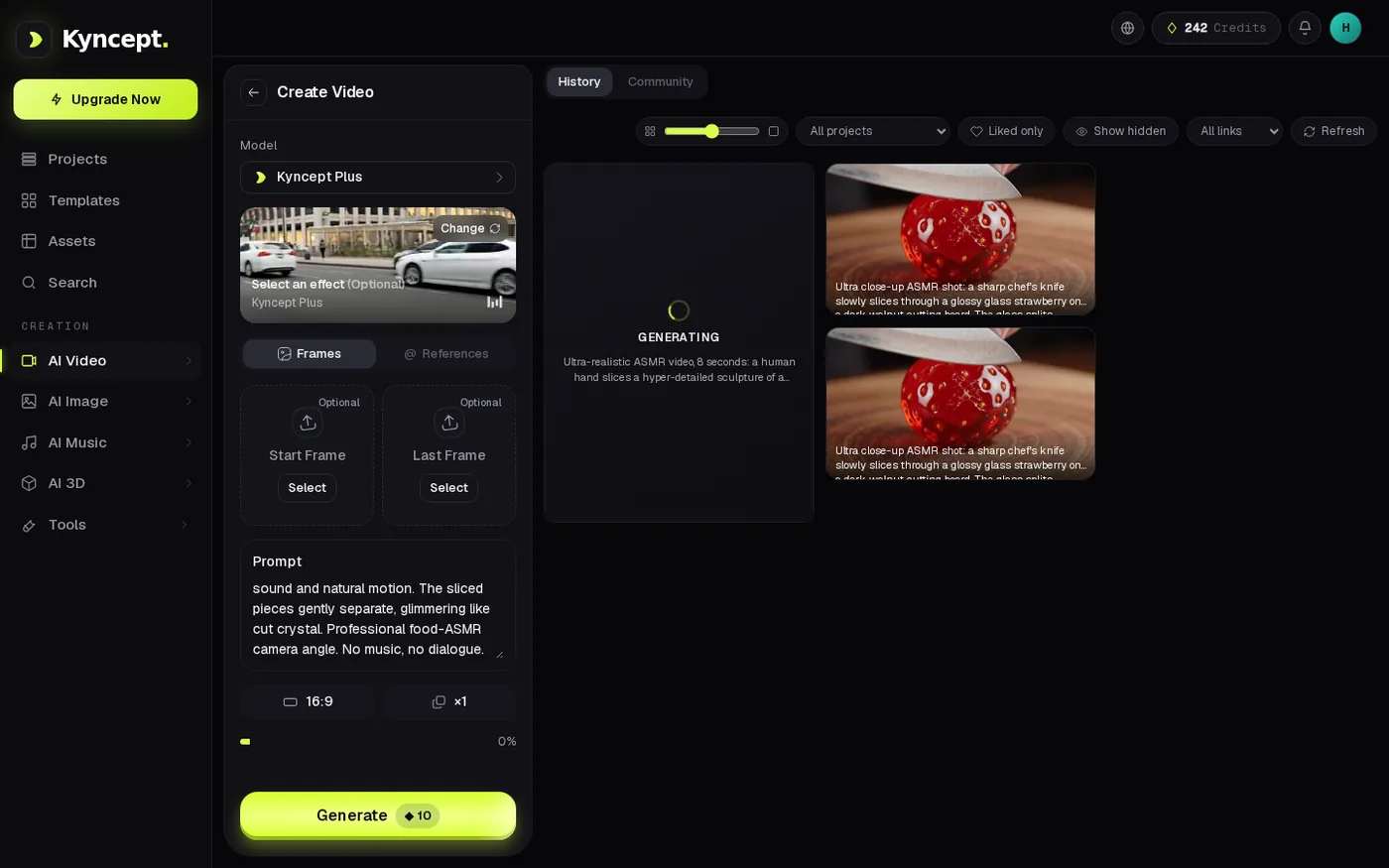 Kyncept queued and generating after the 10-credit charge.
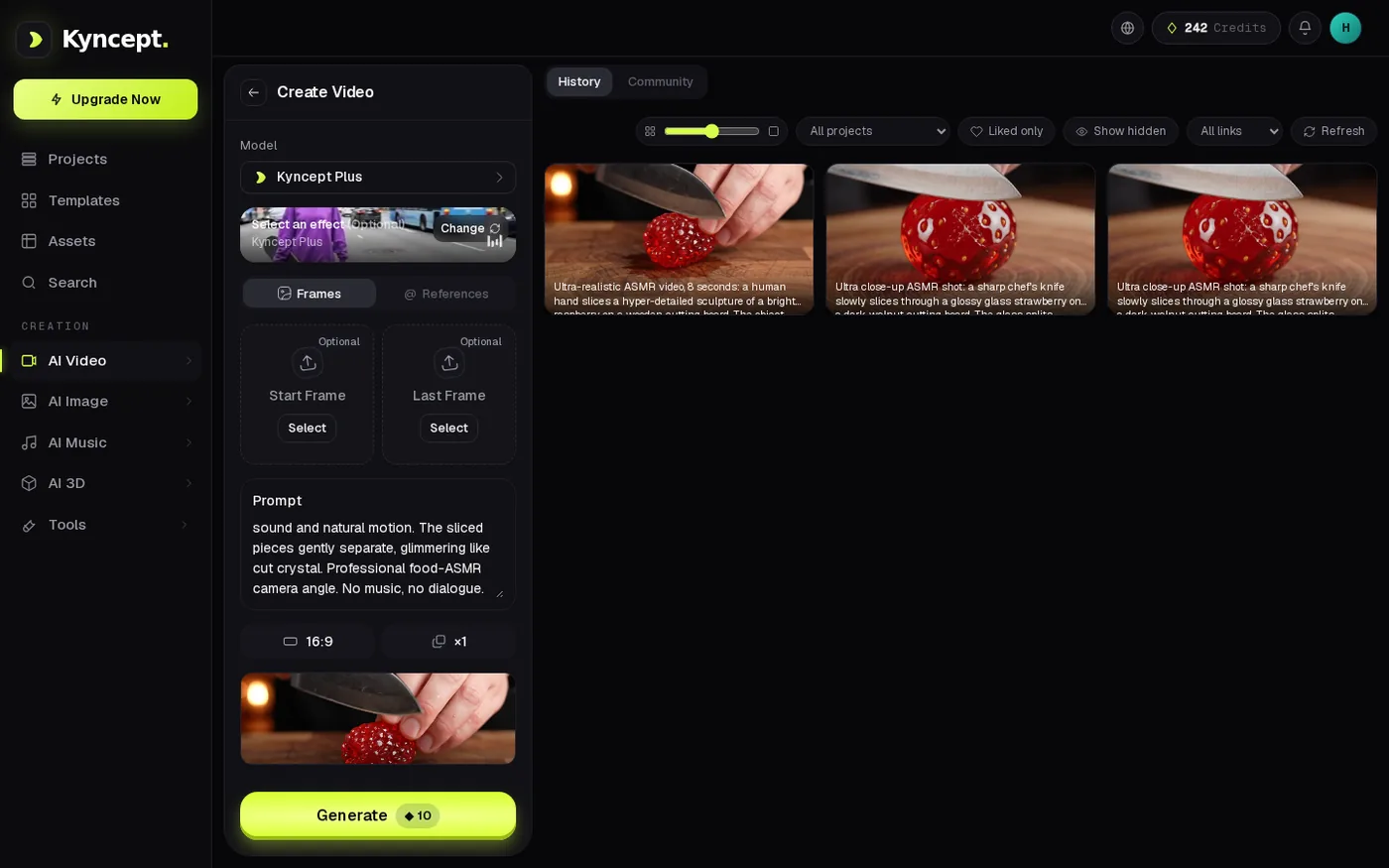 The result: a sliced glass raspberry, 8 seconds, with sound.
What the 8-second Kyncept clip actually contains
I downloaded the file and read it. The first clip is 8.0 seconds, 1280×720, 24 fps, H.264, with AAC stereo at 48 kHz and 140 kbps, and its peak volume is −3.6 dB — the slicing sound is really in the file, not just in the prompt. Size: 2,224,890 bytes. The second attempt is a separate sample rather than the same render counted twice: 2,226,389 bytes, and the two are frame-different.
Against the prompt: one hand and one glass raspberry, yes; a wooden cutting board, yes; realistic slicing sound with no music and no dialogue, yes. The one miss is the cut count — the prompt allowed 2 to 3 separate cuts and the clip makes about 2. That is the single place where the render came in under the brief.
 Four frames from the first Kyncept clip: the knife down, the cut, the two halves separating.
 Four frames from the second, independent Kyncept clip.
Use case C and A: the first try, then 30 clips a month
C — first try, prompt only, no start frame. Kyncept produced a clip on the first attempt in 157.7 seconds. Higgsfield produced 0 clips: Higgsfield's cheapest text-to-video model needs 20 credits against a 4.0-credit balance, the click hit the UPGRADE REQUIRED wall, and nothing was charged. One tool turned a paragraph into a video; the other turned it into a pricing page.
A — an account posting 30 eight-second clips a month:
- Higgsfield — 30 × 20 = 600 credits; the Starter plan holds 270, so the cheapest plan that fits is Plus at €59/month
- Kyncept — 30 × 10 = 300 credits; fits Starter at $19/month (400 credits)
- Monthly bill — Higgsfield €59 · Kyncept $19 · 3.1×
- Per year — 360 clips: 7,200 Higgsfield credits · 3,600 Kyncept credits · 2×
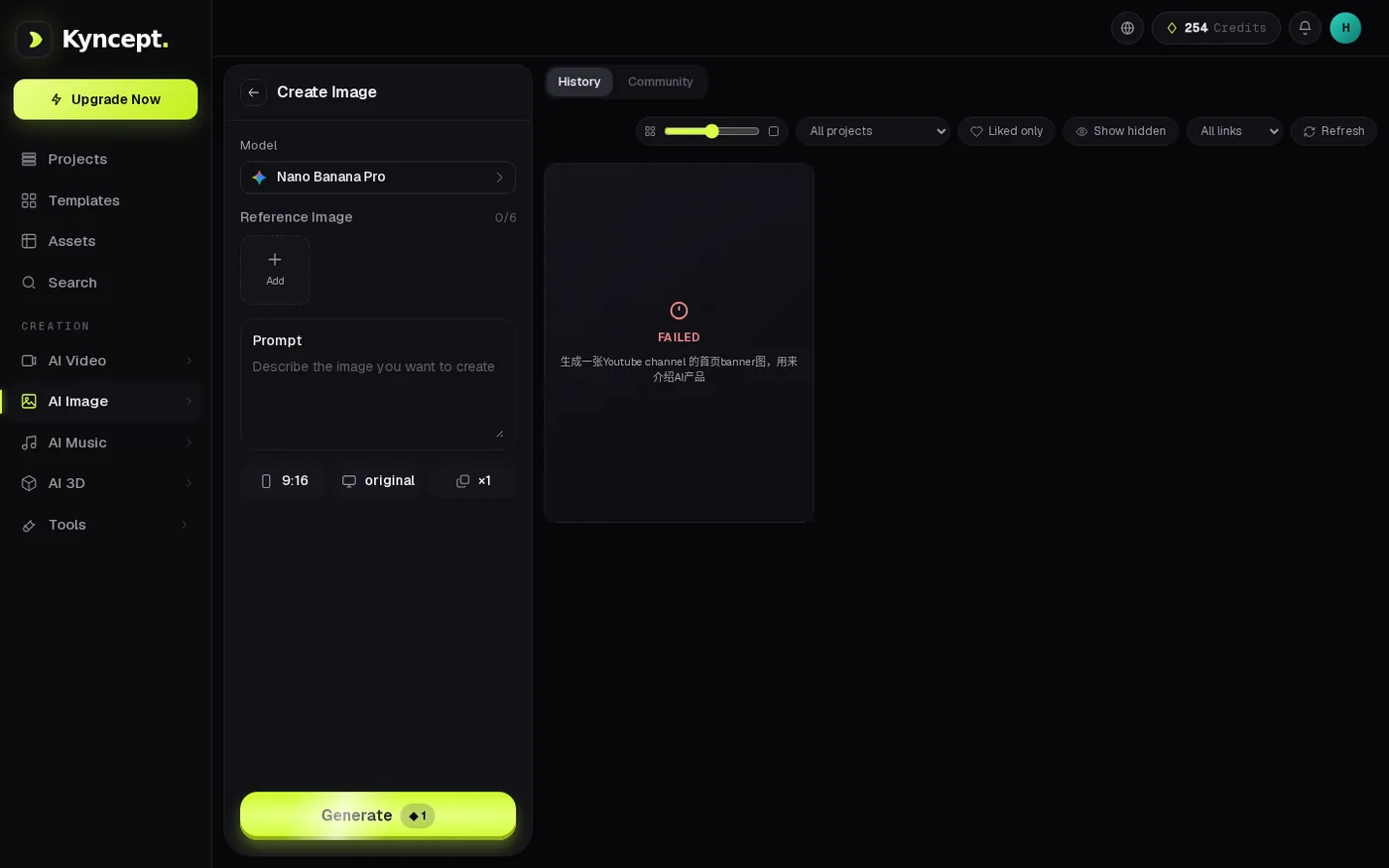 The Kyncept balance used for the before/after reading: 242 before the clip, 232 after it.
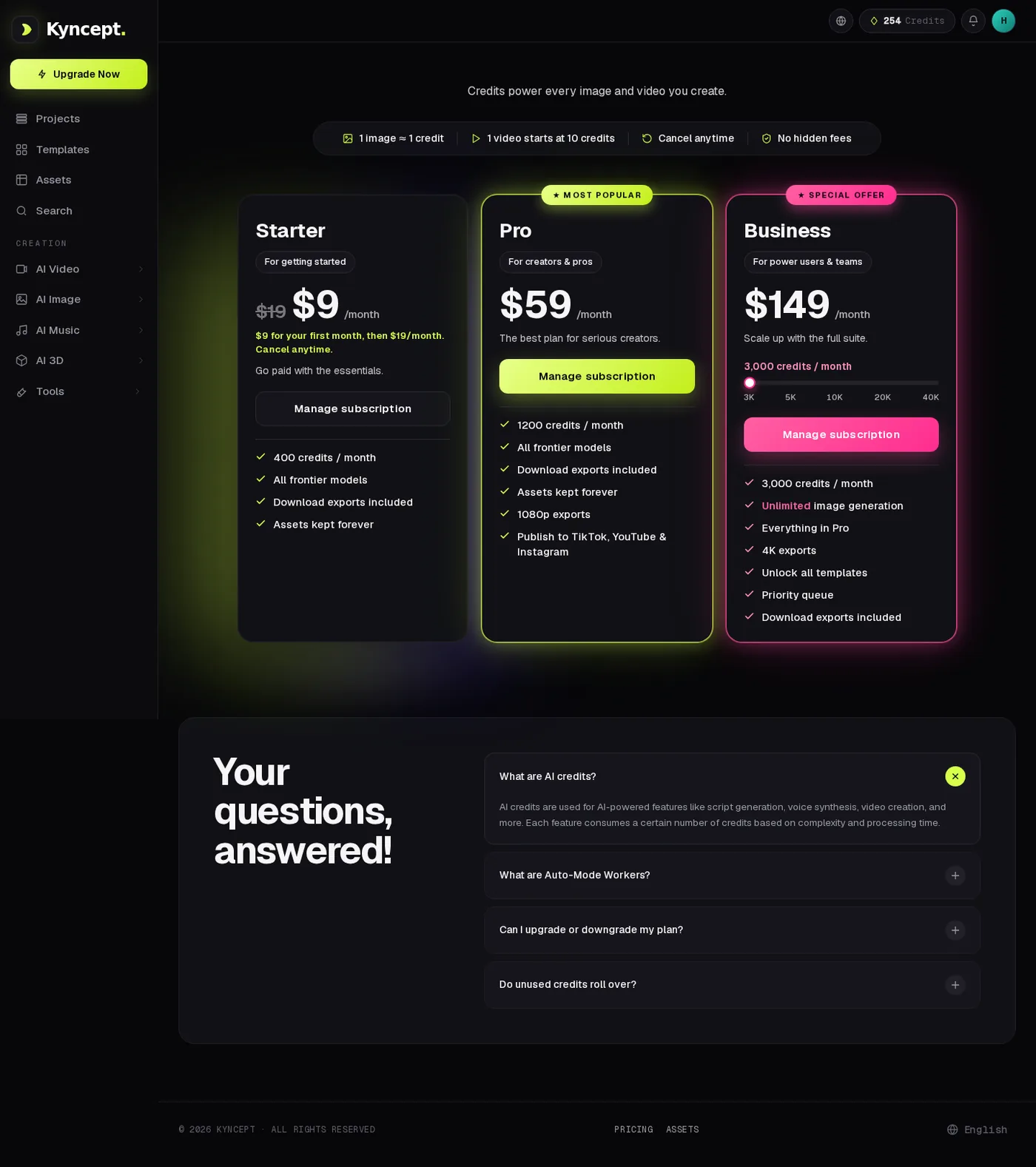 Kyncept's pricing page: "1 image = 1 credit", "1 video starts at 10 credits", Pro $59 for 1,200.
Where Higgsfield genuinely wins
Higgsfield's catalogue and concurrency, and both come with an exchange rate. Higgsfield lists 28 video models and 250+ camera presets against Kyncept's one-model-per-page flow, and it gives up to 8 concurrent jobs on Ultra — while its own free tier is capped at 1, which is the tier a first-timer is on. The exchange rate: the cheapest item in that catalogue costs 20 credits, a free balance holds 4.0, so the catalogue's practical value on a free account is exactly 0 clips.
On the image side the two tools ran the same public model, Nano Banana Pro, and the price differs by 2×: 1 credit on Kyncept (balance 230 → 229) against 2 credits on Higgsfield (4 → 2), a figure Higgsfield's own table confirms: 600 Nano Banana Pro generations per 1,200 credits. Quality came out a tie, and it should, because it is the same model: with the prompt asking for exactly 6 stages, one DNA-inspired line, one anatomy callout per stage and a years-ago number, Kyncept delivered all of it in 2 of 2 images and Higgsfield delivered it in 2 of 3 — its third printed the "Soft Mouth" callout twice. Same model, same picture, twice the credits.
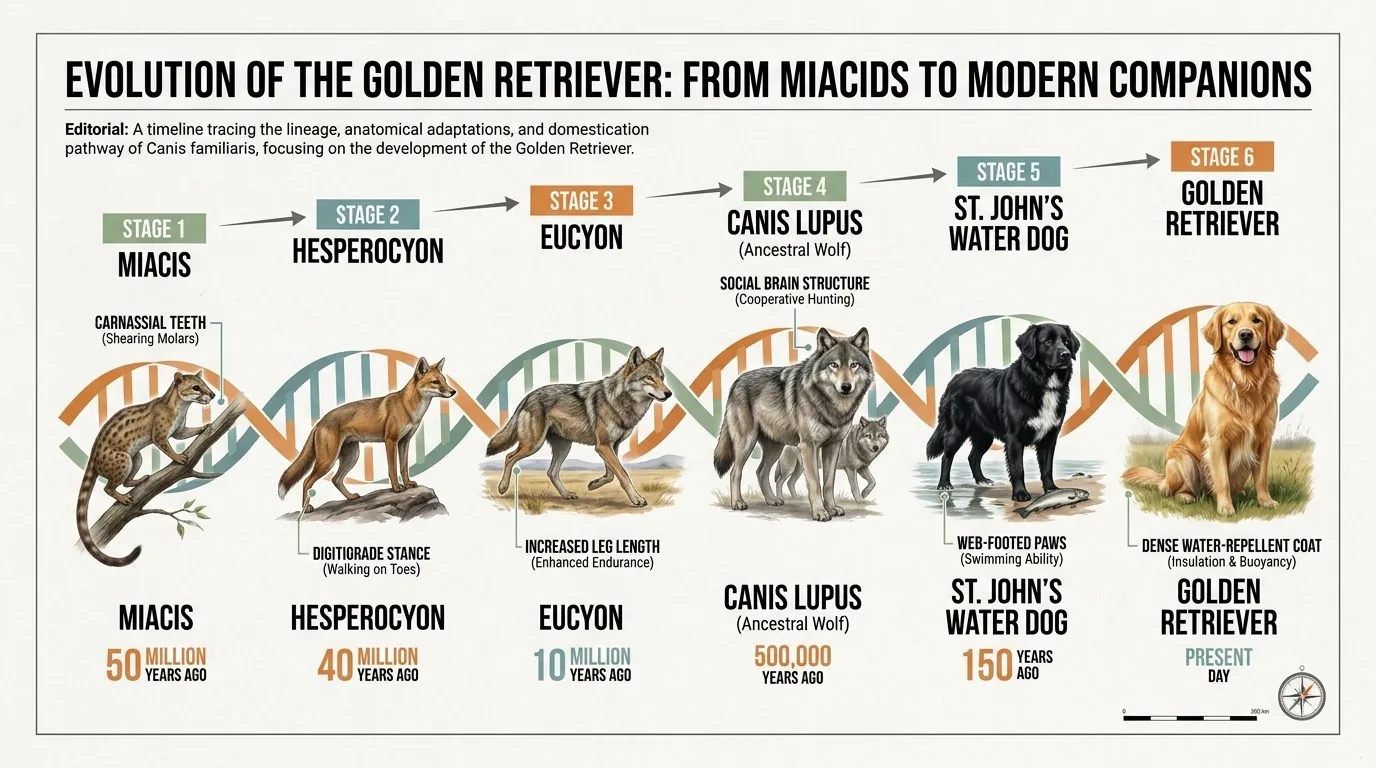 Kyncept's image: 6 stages, a DNA-inspired line, 6 anatomy callouts and a years-ago number on every stage.
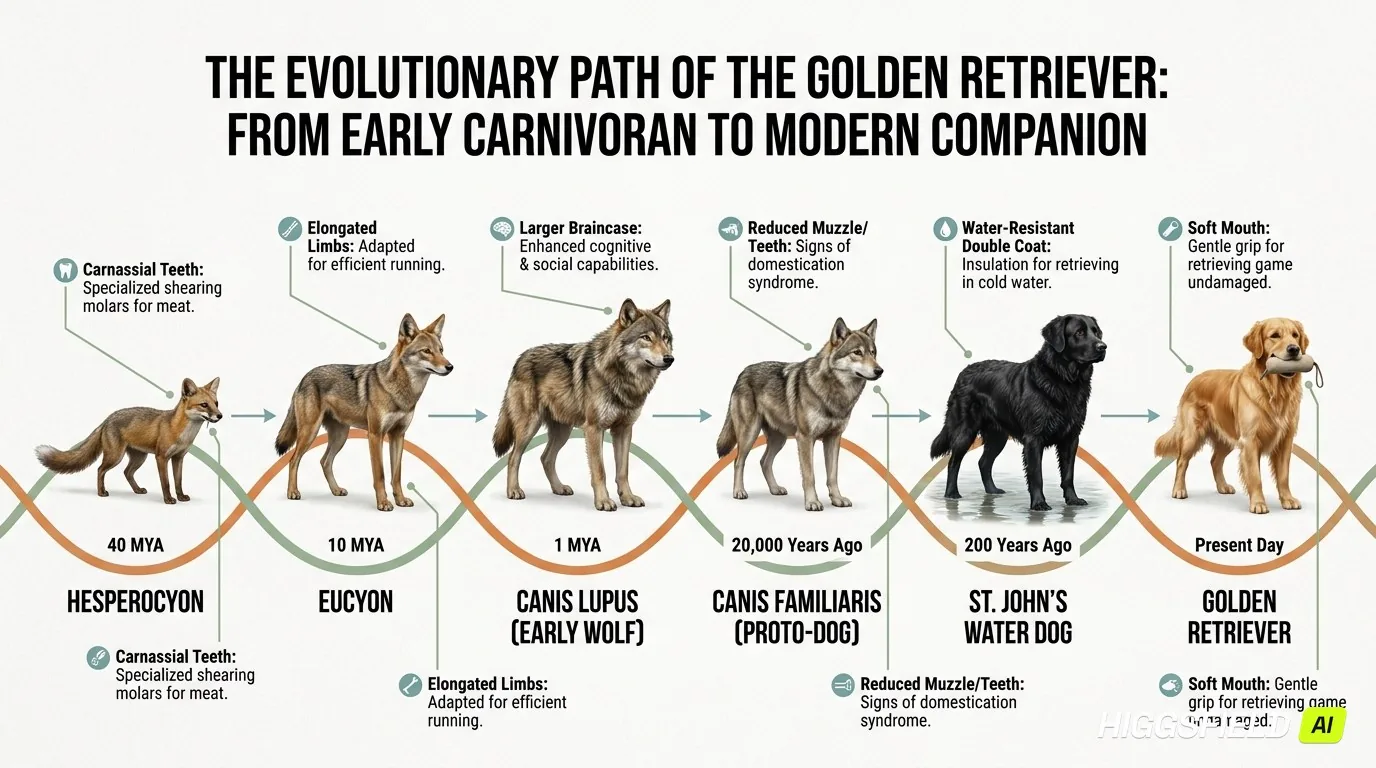 Higgsfield's third image from the same model and prompt: the "Soft Mouth" callout is printed twice.
Final verdict: Higgsfield scores 57/100 for prompt-only text-to-video
For a first-timer with nothing but a text prompt, the Higgsfield free tier produced 0 clips: the cheapest text-to-video model costs 20 credits against a 4.0-credit balance, and the Generate click returned a full-screen upgrade page, with nothing generated and nothing charged. That same Higgsfield session carried 3 promotional surfaces, an Elements toggle on by default, and a 28-model catalogue priced 5× out of reach. On paid plans the gap narrows but does not close: the same 8 seconds costs 20 credits on Higgsfield and 10 on Kyncept, so a 1,200-credit month buys 60 clips one way and 120 the other. Higgsfield keeps its points for catalogue size, presets and concurrency — real advantages I would not argue with — and loses this review on the one job it was tested for.
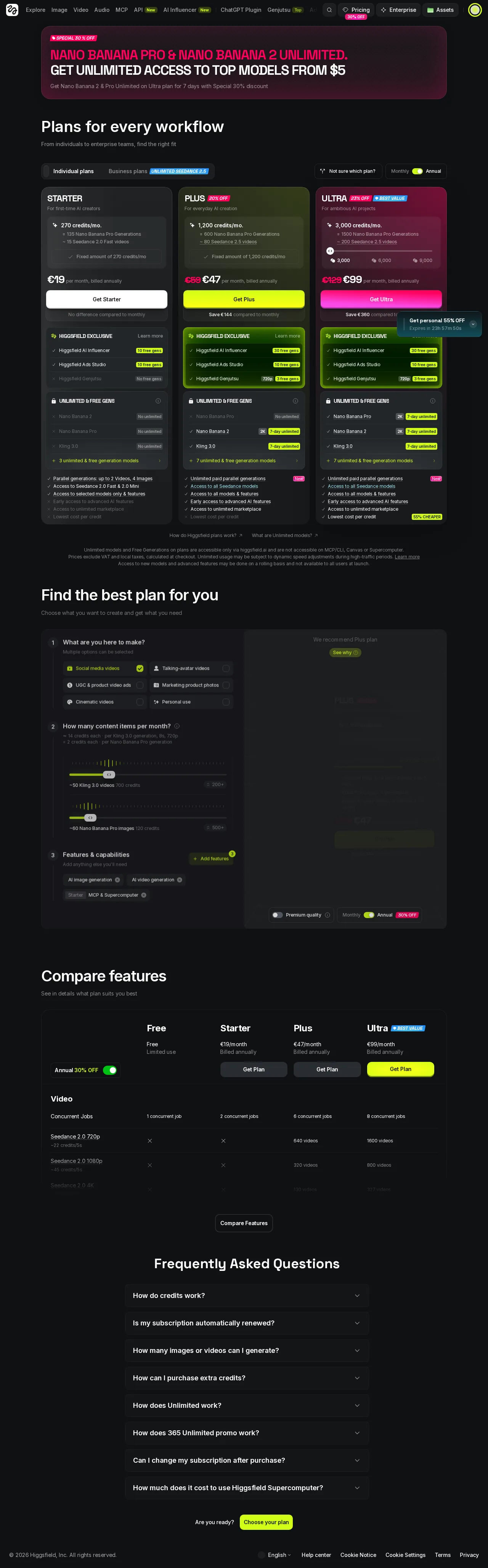 Higgsfield's own pricing table: 1,200 credits = 600 Nano Banana Pro generations, ~ 80 Seedance 2.5 videos.
Which one I would use for this job
If you have a sentence and want a video with sound out of it today, I would use Kyncept: 10 credits, 157.7 seconds, 8 seconds of 720p with audio, first try, and 120 such clips on the 1,200 credits that buy 60 on Higgsfield. Paste the same glass-raspberry prompt at kyncept.com and put the result next to your own Higgsfield attempt.
Originally published on Medium: Higgsfield AI Video Review 2026: Zero Clips From a Free Text Prompt.